Snakes and Ladders game
by The Beast!
(Boardgame Beast HQ)

 Snakes and Ladders
Game manufacturer:
Multiple (open copyright)
Number of players:
2-6
Quick verdict
A classic and very simple board game, designed to appeal to kids, the Snakes and Ladders game (also known as Chutes and Ladders) will not hold much appeal for older family members, but is a perfect first board game.
The game and gameplay
Snakes and Ladders (known as Chutes and Ladders in north America) is a fun, simple board game for kids. There are numerous versions of the game, as the design is not trademarked by one company.
 Some game versions try to teach moral lessons, showing children performing bad acts at the top of the snakes or chutes before they fall, while the kids doing good things at the bottom of the ladders get their reward by climbing the ladder.
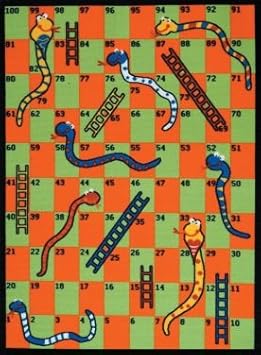
The Snakes and Ladders board gamewill vary from version to version, but the most common format is a 10 x 10 grid, numbered from 1 to 100. Players start on the first square, roll a die and move according to the number indicated. If they stop at the bottom of a ladder, their piece is boosted up the board by climbing it.
However, landing on a snake’s mouth (or the top of a chute) means they slide back down to the bottom of the hazard.
(This may be one source of the phrase “Back to square one”, as many versions feature an extra-long snake whose tail takes you back to the start.)
The winner is the first player to reach square 100. Some versions require throwing exactly the right number to land on the finishing square.
Pros and cons
The obvious pro is also a con. The Snakes and Ladders board game is a very simple one. There’s no skill involved. The throw of a die dictates the outcome of each turn.
Of course, this makes it a perfect game for younger children who have just learned to count. The novelty of the bonuses and downfalls will of course wear off in time, but it’s a great introduction to board games.
The verdict
Snakes and Ladders will appeal to younger children. It has very limited replay value for older people, but is a good way for a family group to involve the junior members in a game session. It’s also an excellent teaching tool.